
AXIS Bank DEI Certification Workshop
Date & Day: 10th February 2026, Tuesday
Time: 3:30 PM to 6:00 PM
Mode: Offline
Venue: XIM University (New Campus), IC-326
Engagement: AXIS Bank DEI Certification Workshop
Participants: Students of Batch of 2024-2026 & 2025-2027, School of Human Resource Management
Resource Person: Harish Iyer, Head DEI, Axis Bank, India
Faculty Coordinator: Prof. Andrew Dutta
Student PoC: Ms. Rujuta Ashtekar
Objectives:
- Understand the concepts of diversity, equity, and inclusion (DE&I).
- Learn how to bridge the gap between diversity and inclusion through equity.
- Apply DEI principles in real-life situations.
Introduction:
The Diversity, Equity and Inclusion workshop was conducted by Mx. Harish Iyer was attended by a total of 108 participants. The session began with a warm and thoughtful introduction by Ms. Shatakshi Kapoor, Core Member, XIMAHR. She welcomed the speaker and highlighted the importance of Diversity, Equity and Inclusion in creating respectful and equitable spaces within institutions and workplaces.
Workshop
Mx. Harish Iyer opened the session with a creative reference to the song “Tu Khiladi Main Anadi” to explain the concept of interdependence and balance in relationships. Through this example, he illustrated how partnerships, whether personal or professional, function best when rooted in mutual respect and kindness. He explained that at the core of human relationships, individuals often share similar needs and concerns despite outward differences.
During the session, he drew attention to the lived experiences of persons with disabilities. He pointed out that individuals with disabilities often find themselves in situations where they must comfort others in order to ease their discomfort. This observation highlighted how exclusion can operate subtly within social spaces. He further explained that human beings naturally function in tribes, gravitating toward familiarity and similarity. However, inclusion requires consciously moving beyond these instincts. Our biases are often shaped by our upbringing and lived experiences, and inclusion demands that we create synchrony even with individuals we may initially feel uncomfortable around.
Hairsh Iyer provided a detailed explanation of the concepts of bias, prejudice, and stereotypes. He clarified that bias refers to inclinations or preferences that are often unconscious. Prejudice refers to preconceived opinions that are not based on reason or experience. Stereotypes are oversimplified generalizations about a group of people. He emphasized that empowerment does not require changing individuals but rather removing systemic barriers. When such barriers are eliminated, individuals are capable of empowering themselves.
Activity
An interactive equity exercise was conducted during the session. Four volunteers were invited to participate. One enacted the role of a blind person, another enacted a person using a wheelchair, a third enacted a person without hands, and the fourth represented a person without disabilities. Each volunteer was asked to approach the speaker. This activity demonstrated how most systems and environments are designed with a default majority in mind, often unintentionally creating obstacles for others. The exercise reinforced the idea that equity is about ensuring fairness in access and opportunity rather than treating everyone in exactly the same manner.
The speaker emphasized that policies are not truly made on paper but are shaped by underlying values. Without inclusive values, policies remain ineffective and performative. He stated that equity is fundamentally a mindset and that adopting this mindset requires courage and accountability.
PAUSE for BIAS Framework
Harish Iyer also introduced the PAUSE framework as a practical approach to mitigating bias. He encouraged participants to pause before reacting, reflect on their internal assumptions, and choose responses that are thoughtful and inclusive.
A significant portion of the discussion focused on the difference between intent and impact. He explained that positive intent can still result in negative impact, and therefore individuals must take responsibility for the effect of their actions rather than merely defending their intentions. Understanding this distinction is essential to practicing meaningful inclusion.
The evolution of language was also discussed. He explained that as language evolves, it gradually dissolves long standing stereotypes. He suggested that one respectful way to ask others about their pronouns is to first share one’s own. For example, introducing oneself with one’s pronouns creates a safe and open environment for others to do the same.
The session included examples of public figures whose perceived limitations became sources of strength and innovation. These examples reinforced the idea that characteristics often seen as constraints can also propel individuals toward remarkable achievements.
PEER Framework
A video on gender identity was shown, followed by a discussion of the PEER framework. The speaker also explained the humanness versus courage graph, categorizing responses into agitators, partners, self protectors, and people pleasers. Participants were encouraged to reflect on their own positions and consider the role of courage in fostering inclusive environments.
The session concluded with a powerful message that the “onus of inclusion lies with those who are already included and not with those who are excluded”. This message underscored the importance of accountability and proactive engagement in building equitable spaces.
Conclusion
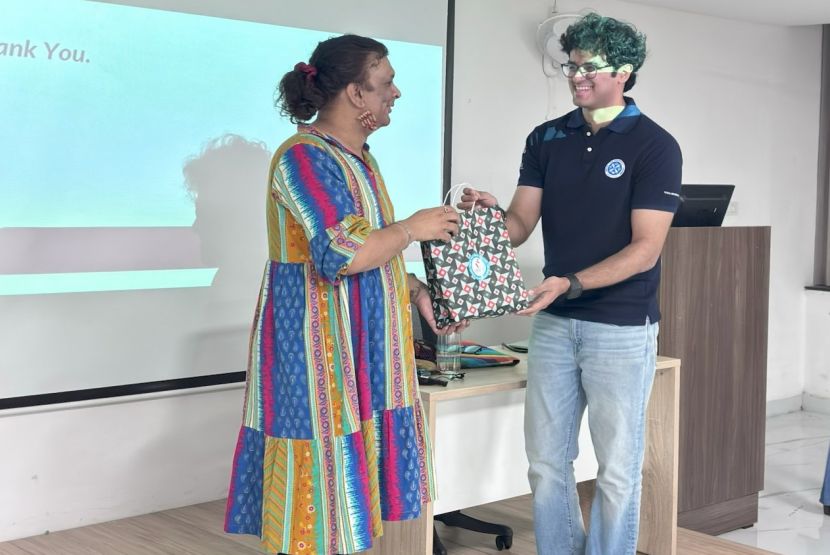
As a token of appreciation, Mr. Akshat Pandey, Deputy Coordinator, XIMAHR, presented a memento to Mx. Harish Iyer. The workshop concluded with a sincere vote of thanks delivered by Ms. Rujuta Ashtekar, Coordinator, XIMAHR, who expressed gratitude to the speaker, the organizing team, and all participants for their active engagement and contribution to the success of the event.