
SCHOOL OF HUMAN RESOURCE MANAGEMENT
Immersion Course “Talent Management & Transformations”
Date: 10th January – 11th January 2026 , Mode: Offline, Venue:IC-345, International Center, XIM University (New Campus), 12(A). Nijigada, Harirajpur, Odisha.
Engagement: Immersion Course
Participants: Students of School of Human Resource Management (Batch of 2024-26)
Resource Persons: Mr. Rajdeep Chakraborty, Group Manager, Talent Management & Transformations, Bosch
Faculty Coordinator: Dr. Andrew Dutta, Dean, School of Human Resource Management
Student PoC: Ms. Rujuta Ashtekar (Coordinator, XIMAHR)
OBJECTIVE
- To develop a clear, practice-oriented understanding of Talent Management, including what it truly entails in organizational contexts and what it does not, grounded in real industry reflections.
- To enable participants to apply strategic talent planning concepts by identifying, aligning, and forecasting talent needs with business strategy through structured exercises and real-world scenarios.
- To build practical insight into how organizations identify critical talent, including high potentials, key roles, and future-ready capabilities, using both structured frameworks and managerial judgment..
- To understand how organizations design and implement career planning systems, focusing on employee growth, succession readiness, and long-term capability building.
- To introduce Agile Project Management principles and connect its relevance to managing talent initiatives, change, and talent transformation programs.
- To equip learners with the ability to view talent transformation as a project, integrating Talent Management, Change Management, Agile Project Management and needs of clients facing specific HR challenges.
COURSE OVERVIEW
This course offers an industry-oriented exploration of Talent Management and Transformation, focusing on how organizations extensively manage talent via 4 major aspects – Workforce Planning, Talent Assessment & Identification, Career Management, & Succession Planning. Through practical frameworks, real-world exercises, and industry reflections, participants gain hands-on exposure to strategic talent decision-making. The course also introduces Agile Project Management & Change Management concepts relevant to managing talent initiatives effectively. Overall, it enables learners to view talent transformation as an integrated, execution-driven CoE aligned with business strategy.
INTRODUCTION
The Immersion Course was commenced by Ms. Poorvi Sharma, Core Member, XIMAHR, who introduced Mr. Rajdeep Chakraborty to the students and handed over the session to the speaker.
Mr. Rajdeep set the tone by first encouraging participants to share their understanding of the term “Talent”and looking up the JD of a Talent Head, following which he introduced the course outline and the Talent Management pipeline along with its key phases. Each phase of the pipeline was then explored in depth across the six sessions of the course.
KEY TOPICS & MODULES
Session 1: What is Talent Management & what it is not? Reflections
- Rajdeep posed several thought-provoking questions, such as the fundamental meaning of talent, whether talent refers to a person or a role, whether top leaders are necessarily part of the talent pool, and what the role of a Head of Talent Management truly entails.
- He addressed these questions from a practitioner’s perspective, explaining that talent managers typically focus on managing a small, high-impact cohort drawn from a much larger employee base. This cohort may, but does not necessarily, comprise individuals in leadership roles. A key insight that emerged was: while all leaders are considered talent, not all talent are leaders.
- He highlighted major challenges in Talent Management including the lack of a consistent definition, as the meaning and scope of talent vary significantly across organizations.
- Industry examples from Wipro were shared, where the top 100 employees were formally recognized as the talent cohort. However, this approach inadvertently discouraged the next 100 high-performing employees who were also competent.
- The session also introduced the core sub-functions of Talent Management, including workforce planning, talent assessment and identification, career management, and succession planning.
- It was emphasized that talent planning begins with roles, after which organizations identify and align individuals who best fit those roles.
Session 2: Talent / Workforce Planning
- The second segment moved deeper into Workforce Planning with the aid of Excel based calculations.
- Various steps of Workforce planning used in organisations were taught which included Strategic Planning, Demand Analysis, Supply Analysis, Gap Identification.
- Quantitative methods were applied on Excel through real world examples to calculate the Gross Demand, Gross Supply and the HeadCount (HC) required for the next year based on numbers from previous years.
- Approaches to business assumptions & business needs were taught to help arrive at the most accurate number of Workforce HC required. In this, various kinds of conversations that must be done with the business heads to align with their needs was discussed.
- Various concepts such as Time & Material Cost Method, Fixed Cost method were introduced that affect the calculation of Workforce Planning.
- Build, Buy, Borrow concepts of workforce planning were taught and logical approaches to divide the talent demand into these 3 categories were discussed.
Session 3: Talent Identification: Theory & Practice
- Building on the identification of headcount (HC) requirements through workforce planning, this session focused on designing the right set of assessments and evaluations to effectively differentiate true talent from the larger employee pool.
- The session included a discussion on participants’ understanding of Assessment Centres (ACs) and Development Centres (DCs), clarifying their purpose, application, and strategic relevance in talent identification.
- The key phases of Talent Identification were explained as: Nomination Assessment / Evaluation Decision-making Feedback and Development Planning.
- An in-class debate titled “To gate or not to gate?” was initiated to examine whether Assessment Centres should function as strict elimination gates based solely on scores, or whether flexibility should be allowed by incorporating an employee’s past performance and track record.
- The nomination criteria for Assessment Centres were discussed, including weightage given to performance, career aspirations, managerial recommendations, organizational fit, and eligibility filters.
- The strategic use of Development Centres was highlighted as a more inclusive approach, particularly in managing on-ground organizational politics that may arise when ACs are used as rigid gates. DCs are a developmental and politically safer alternative, while maintaining high levels of validity, reliability, and accuracy among assessment methods.
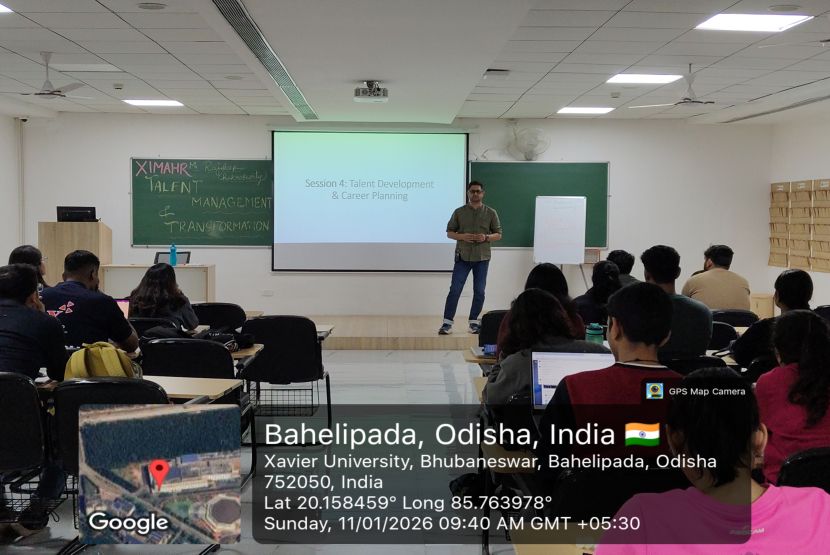
Session 4: Talent Development & Career Planning
- Building on students’ prior understanding of competency mapping, the session began with a discussion on identifying the fastest and most effective approaches to competency mapping when faced with tight timelines of a few months.
- Emphasis was placed on Job Analysis as the foundational step, followed by the use of a competency dictionary to map Task, Duties, and Responsibilities to the most relevant competencies for target roles. A Harvard competency dictionary was examined to understand this process in practice.
- The session addressed practical workplace challenges that often arise after talent selection, such as employee resignations, immediate demands for promotion without a probation period, and situations where individuals are already performing the responsibilities of the role they seek to be promoted into. These challenges highlighted the need for personalization in Talent Management design, particularly within a Centre of Excellence (CoE) framework.
- A discussion followed on designing dual-nature policies to enable personalization: Type 1: Customized Individual Development Plans (IDPs) tailored to each employee. Type 2: IDPs with varying timelines, recognizing that development journeys differ across individuals This approach introduced the concept of “Flexibility by Design” in career and talent development systems.
- The importance of a Credits Plan was explained as a tool for both personalization and political management, where employees are allocated a defined number of credits across Experience, Exposure, and Education (commonly aligned with the 70–20–10 framework).
- It was emphasized that once the HR business objective of the Development Centre (for example, promotions into critical roles) is achieved, it formally marks the completion of the Talent Management cycle.
- The session concluded with an applied understanding of Training Effectiveness in Career Management, using the Kirkpatrick Model and integrating it with lead and lag indicators to measure development impact.
Session 5: Change and Agile Project Management tied to Talent Transformations
- Talent Transformation was introduced as a set of “meta processes” that must be deliberately designed to enable the Talent Management phases discussed in earlier sessions. The focus was primarily on Change Management and Agile Project Management as key enablers.
- Organizational Development (OD) was explained as a meta process, with Kotter’s 8-Step Change Model presented as a widely adopted framework in organizations. Students were asked to map all eight steps to typical Talent Management change initiatives to illustrate practical application.
- The concept of a compelling change equation was discussed, emphasizing that the perceived benefits of change must outweigh the effort required to plan and implement it. To operationalize this, participants were introduced to a benefits calculation table to quantify benefits and costs in INR Value.
- The importance of forming a guiding management coalition to drive change was highlighted. In the context of Talent Management, this coalition typically includes: The Project Sponsor (often the CHRO), Governing leaders such as relevant business heads, and Key stakeholders including HR Business Partners (HRBPs) who serve as communicators of change designed by the CoE.
- A comparison between Kotter’s model and the ADKAR framework was discussed, noting that Kotter addresses organizational-level change, while ADKAR focuses on individual-level change. When applied practically, ADKAR translates into three key design elements: a Communication Plan, Training Plan, and Rewards Plan.
- Agile Project Management concepts were introduced, including an overview of Scrum, the role of the Scrum Master, and a practical understanding of the JIRA dashboard for tracking project progress.
- The session also covered foundational project management tools such as the Work Breakdown Structure (WBS) and the PDCA cycle, explaining their layered application from individual sprints to the overall high-level project lifecycle.
Session 6:
- This session involved a hands-on student activity designed to help participants think like talent managers by asking the right diagnostic questions to build a comprehensive Talent Management case.
- Students were divided into groups of four, with each member assuming a distinct professional role: Talent Management Architect (Mercer), Change Manager (Accenture), Scrum Master (EY), HR Business Partner (HRBP) representing the client organization (TCS).
- A broad business context was provided to anchor the exercise:
A large IT organization seeking to revamp its Talent Management practices through a structured change management and project management approach. - Working within this context, students collaboratively developed the case by integrating perspectives from talent design, change management, agile execution, and business partnership.
- The activity enabled students to understand the end-to-end thinking required of a talent manager, emphasizing cross-functional collaboration, structured problem-solving, and execution-oriented talent transformation.
CONCLUSION
At the end of the Immersion Course, the speaker was felicitated with a token of appreciation by Ms. Drishti Singh, Core Member, XIMAHR & Ms. Rujuta Ashtekar, Coordinator, XIMAHR. The Vote of Thanks was delivered by Ms. Poorvi Sharma, Core Member, XIMAHR.
KEY TAKEAWAYS
- Talent Transformation is a business-led meta process, and must be aligned with organizational strategy and impact.
- Talent is defined by role criticality and value creation, not hierarchy, highlighting that all leaders are talent, but not all talent are leaders.
- Strategic talent planning starts with workforce planning which includes Gross Demand & Supply Analysis, followed by identifying individuals who best fit those roles.
- Assessment Centres (ACs) and Development Centres (DCs) must balance objectivity, flexibility, and political realities to ensure fair talent identification.
- Talent Identification operates through structured phases of Nomination, Assessment, Decision, and Feedback/Development Planning.
- Talent Development and Career Planning require personalization through customized IDPs, variable timelines, and “Flexibility by Design.”
- Tools such as Competency Dictionaries, Job Analysis, Credits Plans (70–20–10) enable scalable yet personalized development.
- Agile Project Management (Scrum, JIRA, PDCA, WBS) provides the execution backbone for Talent Transformation initiatives.
- Talent Transformation is most effective when managed as an end-to-end project, integrating talent design, change leadership, and agile execution.


