
Strategic HR Business Partnering in the Digital Transformation Era
Date: 1st & 2nd August, 2025
Mode: Offline
Venue: International Center, XIM University (New Campus), 12(A). Nijigada, Harirajpur, Odisha.
Engagement: Immersion Course
Participants: Students at School of Human Resource Management (Batch of 2024-26)
Resource Persons: Mr. Bhawani Prasad Chaval – MBTI Coach, Founder & CEO of Pramana Educare LLP
Faculty Coordinator: Dr. Andrew Dutta, Dean, School of Human Resource Management
Student PoC: Ms. Rujuta Ashtekar (Coordinator)
OBJECTIVE:
- Analyze the evolution of employee contracting practices across key sectors such as banking, pharma, consulting, and BPO, using real-world contracts and industry benchmarks.
- Understand compliance and ethical frameworks by interpreting labor laws, guidelines, and codes (POSH, ASH, DE&I, DDA), and integrating them into practical HR initiatives.
- Enhance employee relations capabilities through interactive roleplays, live scenarios, and structured grievance-handling techniques.
- Evaluate future-of-work strategies and digital disruptions by exploring cultural shifts, AI integration, and HR’s strategic role in navigating workplace transformation.
COURSE OVERVIEW:
This course empowers professionals to elevate strategic HR Business Partnering in the digital transformation era by aligning talent initiatives with evolving organizational goals, fostering agile workplace cultures, and leveraging data-driven insights to influence leadership and drive measurable business impact.
INTRODUCTION:
The Immersion Course was commenced by Mr. Akshat Pandey, Deputy Coordinator, XIMAHR, who introduced Mr. Bhawani Prasad Chavali to the students and handed over the session to the speaker.
KEY TOPICS & MODULES:
Session 1: Industry Context for HRBP role
- The session began with an introduction to the meaning of the role as an HRBP and students’ understanding on the same was gathered through interactive polling, word cloud creation and the insights were further discussed.
- A qualitative study of real Offer Letters and Employment Contracts from 2000s to 2025 was conducted, where students had to draw comparisons between contracts from various decades, and study the evolution in the policies, and their verbiage.
- Study of aligning contracting strategy to business imperatives: shorter delivery cycles, project-based teams, and global talent markets.
Session 2: Navigating Compliance Frameworks and Ethical HRBP Case Debates
- Explored POSH, ASH, regulations alongside voluntary codes such as dress codes and golden handcuffing.
- Examined live industry compliance practices through case studies and policy audits.
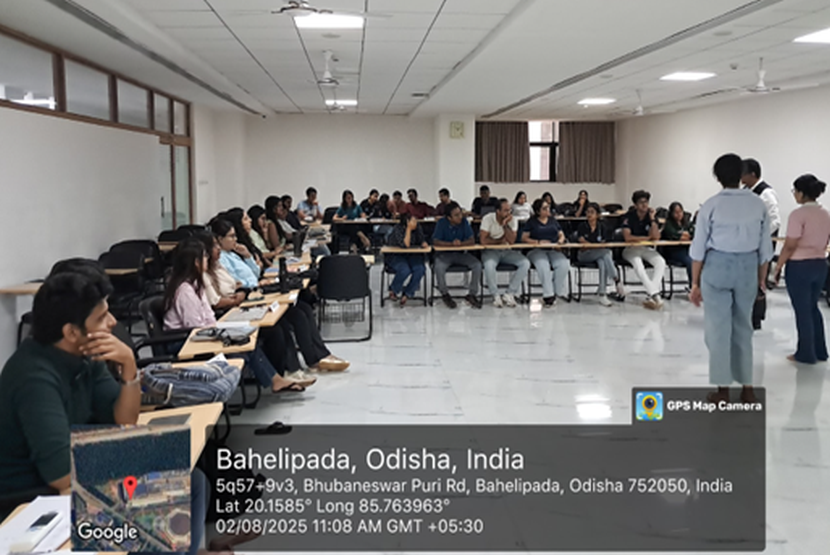
- Group wise case approaches and debates: The students were divided into groups and provided a classic HRBP problem statement each. They had to present their approach to other groups and tackle challenging questions.
- 3 cases discussed in this session revolved around
- Investigating harassment/discrimination grievances: balancing sensitivity, policy know-how, and emotional dynamics.
- Overcoming local pushback on global development programs: customizing rollouts, negotiating billability, and keeping morale high.
- Communicating unwelcome news (denied promotions, minimal hikes, layoffs): crafting empathetic scripts while upholding policy fairness.
Session 3: Strategic Workforce Management and Crisis Response
Further cases were discussed to sharpen practical skills and strategic thinking:
- Addressing underperformance, conflicts, and staff shortages: diagnosing root causes, rolling out targeted improvement plans, mediating resource disputes, and deploying contingency staffing measures.
- Handling health emergencies and fatalities: acting as first responders in critical crises, coordinating with families and authorities, and managing the intense emotional toll.
- Managing organizational change and workforce transitions: designing and coaching leaders on hybrid/remote work models, safeguarding culture and engagement, and plotting long-term workforce planning.
Session 4: Upskilling Managers, Unbiased Feedback, and Mercer Insights
- Understanding of designing agile OKR (Objectives and Key Results) frameworks aligned to quarterly business sprints.
- Study of continuous upskilling of line managers in change management and digital dexterity, in line with Mercer’s “workforce reimagined” trend.
- Techniques to guide leaders and managers on unbiased digital feedback collection.
- The movie “Up in the Air” was a practical case study to observe the HR professional’s ability to deliver difficult messages with empathy, maintain personal connection despite physical distance, and manage both individual emotions and organizational priorities.
- Discussion on contrasting the film’s analogue approach with Mercer’s recommendation for digitalized support tools like AI-driven coaching bots and virtual peer support networks to scale empathetic outreach.
Session 5: Employee Engagement and Skill Development Policies
- Understanding the shift personalized upskilling journeys using adaptive learning platforms (e.g., Coursera for Business, Degreed)
- Practical case study: An organization used data-driven analytics to uncover personalized learning gaps for over 24,000 employees but couldn’t sustain the initiative due to budget overruns and a mismanaged training delivery model that couldn’t scale customized solutions.
- ROI measurement framework: correlate learning hours, certification completions, and performance uplift. Discussion of the need for verifying the authenticity of the Learning KPIs.
Session 6: Future of Work Trends and Digital HR Enablers
- Interpreted the impact of generative AI on job design, creativity cycles, and collaboration norms and processes.
- Data driven insights from IBM were discussed to shed light on the need for AI governance investments. The students were provided with various cases of how organisations race to adopt AI, but lacked the budgets to govern their AI models, leading to data breaches, and non compliances.
- Analysis of WEF Report on Transformative trends, where the rise of Human-Machine Collaboration trends in transactional, relational and expertise roles was discussed.
- Understanding of AI generated Talent Analytics types – Descriptive, Diagnostic, Predictive & Prescriptive. Use Case of Phenom Software was discussed.
CONCLUSION:
At the end of the Immersion Course, the speaker was felicitated with a token of appreciation and a Vote of Thanks was delivered by Ms. Rujuta Ashtekar, Coordinator, XIMAHR.
KEY TAKEAWAYS:
- Shift to consultative HRBP partnerships that co-create solutions and align HR goals with business strategy for measurable impact.
- Harnessing workforce analytics and learning-tech platforms to pinpoint skill deficiencies across employee cohorts. Leveraging personalized insights lets you design targeted interventions that optimize budgets and boost performance.
- Move beyond order-taking by mastering consultative questioning and stakeholder-mapping techniques.
- Going beyond the textbooks: On ground techniques to handle challenging & sensitive workplace situations & dilemmas faced by HRBP.
- Co-design programs with business leaders to balance people needs and commercial objectives, earning trust and driving sustainable change.
- Role of HRBP in AI governance policies and employee data safeguarding.


