
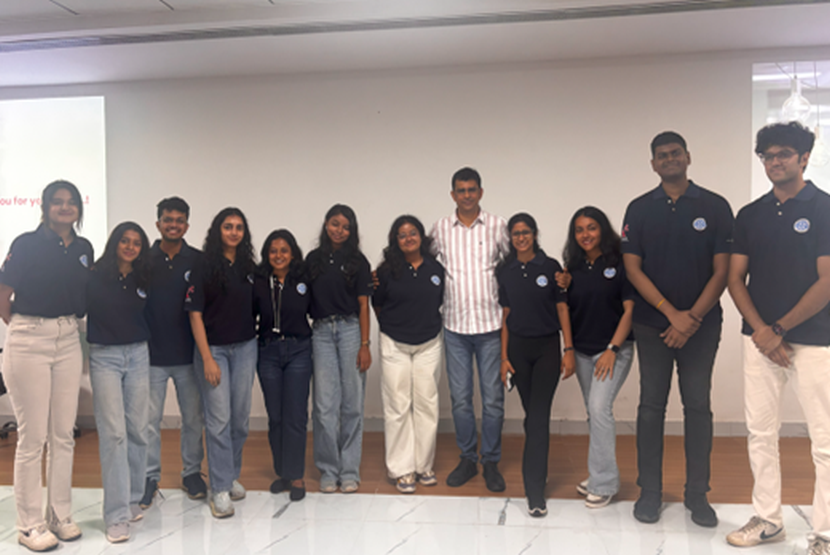
AI-Powered HR Simulations: Ensuring Fair Compensation with Pay Equity Audits & Workforce Budgeting
Date: 1st & 2nd August, 2025
Mode: Offline
Venue: International Center, XIM University (New Campus), 12(A). Nijigada, Harirajpur, Odisha.
Engagement: Immersion Course
Participants: Students at School of Human Resource Management (Batch of 2024-26)
Resource Persons: Mr. Suman Paul – Director Rewards, South & North Asia – Dentsu International
Faculty Coordinator: Dr. Andrew Dutta, Dean, School of Human Resource Management
Student PoC: Ms. Rujuta Ashtekar (Coordinator)
OBJECTIVE:
- Explore the strategic role of compensation and reward management in aligning employee motivation with organizational performance by understanding foundational models, frameworks, and emerging practices.
- Analyze the influence of business strategy on reward decisions and structures, and evaluate models for total rewards that support talent attraction, retention, and segmentation.
- Apply principles of internal and external equity to ensure fairness, competitiveness, and compliance in pay practices, using industry benchmarks and compensation analytics.
- Leverage AI and data-driven tools to optimize reward decisions across the employee lifecycle, enhancing ROI and enabling differentiated value propositions for diverse talent pools.
COURSE OVERVIEW:
This course enables HR professionals to design strategic compensation and reward systems aligned with business goals. It focuses on integrating reward frameworks with talent strategy, ensuring internal equity and market competitiveness, and using analytics to enhance decision-making. Participants will explore how to link pay with performance, differentiate rewards by talent segments, and apply AI-driven insights to attract, retain, and motivate employees in a dynamic, digital workplace.
KEY TOPICS & MODULES:
Day 1: Foundations of Strategic Reward
Session 1: Business Strategy & Reward Philosophy
The session opened with strategic linkages between business models and reward approaches.
Real-world examples from FinTech, Retail, and Digital Media illustrated the impact of strategy on compensation structures.
Introduced the 3Ps of Pay: Pay for Position, Pay for Performance, and Pay for Person.
Discussed market positioning strategies: Lead, Match, Lag.
Simulation: Compensation Fitment for Recruitment
Students crafted a fitment plan for a Branch Manager hire, balancing internal equity, external benchmarking, and variable pay design.
Session 2: Pay Mix, Structure, and Equity
Deep dive into pay mix design across cadres – from entry-level to executive roles.
Covered internal equity using the Hay Job Evaluation Framework.
Discussed external equity through market benchmarking and compa-ratio interpretation.
Highlighted equity anomalies such as red-circling and overlapping pay ranges.
Simulations:
Job Banding using K-Means Clustering
Compa Ratio & Catch-up Cost Computation
Session 3: Pay Range Architecture & Visualization
Focused on designing pay ranges with logical midpoints and progression spreads.
Explored scatter plot and box plot tools to visualize pay spread, outliers, and skewness.
Participants used analytics to validate compensation decisions and refine salary structures.
Simulation: Pay Range Visualization & Salary Band Distribution
Day 2: Performance-Linked Pay, Incentives & Analytics
Session 4: Performance-Based Rewards
Introduced merit increase modeling based on performance ratings and compa-ratios.
Discussed talent segmentation using performance grids and CAGR metrics.
Focused on optimizing increment budgets with fairness and strategic alignment.
Simulations:
Annual Salary Revision Matrix
Performance Bonus Payout Calculation using multipliers (Individual x Business x Company)
Session 5: Incentive Design & Pay-Mix Rebalancing
Detailed frameworks for sales incentive scheme design across multiple KPIs.
Addressed pay mix harmonization during M&A situations and restructuring.
Emphasis on aligning incentives with behavioral and financial outcomes.
Simulations:
Sales Incentive Scheme Design (FMCG + Banking)
Pay-Mix Rebalancing for Acquired Entities
Session 6: AI in Rewards & Executive Compensation
Overview of AI/ML models for HR: regression, clustering, and classification techniques.
Demonstrated the use of analytics to detect pay gaps and bias in compensation.
Covered Executive Pay Architecture – ESOPs, LTI, vesting, and clawback clauses.
Touched upon reward governance under SEBI, Companies Act, and RBI guidelines.
Simulations:
Salary Prediction via Regression
Reward Optimization using Linear Programming
CONCLUSION:
At the end of Day 2, a heartfelt vote of thanks was extended to Mr. Suman Paul for his deep industry insights. As a token of gratitude, a memento was presented by Prof. Subhra Pattnaik, acknowledging Mr. Paul’s contribution and time.
KEY TAKEAWAYS:
- Business-Linked Rewards: Aligned compensation strategy with business models like cost leadership and innovation.
- 3Ps of Pay Philosophy: Integrated approach of Pay for Position, Performance, and
Person. - Equity in Compensation: Ensured fairness through internal job evaluation and external market benchmarking.
- Analytics-Driven Decisions: Used AI/ML tools for salary prediction, incentive design, and reward optimization.
- Future-Ready Frameworks: Covered executive compensation, ESOPs, and pay mix
harmonization in dynamic environments. - Compliance & Governance: Incorporated regulatory standards from SEBI, RBI, and
Companies Act in reward design.


