
SCHOOL OF HUMAN RESOURCE MANAGEMENT
KSHITIJ 2025 (ANNUAL HR CONCLAVE)
Date & Day: 06.12.2025, Saturday, Time: 10:30 AM to 4:30 PM, Mode: Offline,
Venue: Mini Auditorium, XIM University (New Campus), 12(A). Nijigada, Harirajpur, Odisha.
Engagement: Annual HR Conclave
Participants: Students of School of Human Resource Management
Resource Persons:
Keynote Speaker: Mr. Priyadarshi Mohapatra, Founder & CEO, CureBay
NHRDN Bhubaneswar Chapter President: Ms. Bobby Patnaik, AVP HR Business Leader, Infosys & President, NHRDN Bhubaneswar Chapter
Panelists:
- Ms. Annapurna A – Director – Global Learning & Talent Development, and HR & Admin (India) – Fime, Founder – Emotionalytics and Co.
- Dr. Dinesh Murugesan – Head Global Capability Center (GCC), dsm-firmenich
- Ms. Saema Javed- Head of HR & Admin – India & Middle East, AIT Worldwide Logistics
- Mr. Satyadeep Mishra – Chief Human Resources Officer, R Systems
- Mr. Shyam Sundar Choudhury – Chief – Business HR (Odisha DISCOMs),
Tata Power
- Mr. Sasanka Sekhar Pati – Head HR, Cozentus Technologies
Moderator: Dr. Sanjay Bhattacharya, School of HRM, XIM University
Faculty Coordinator: Dr. Andrew Dutta, Dean, School of Human Resource Management
Student PoC: Ms. Rujuta Ashtekar, Coordinator, XIMAHR
Objectives:
- To explore the theme “The Skills-First Era: Redefining Talent in an AI-Transformed World” through a panel discussion among esteemed industry leaders.
- Case competition to foster innovative solutions aligned with the conclave theme.
Details:
Inaugural Ceremony:
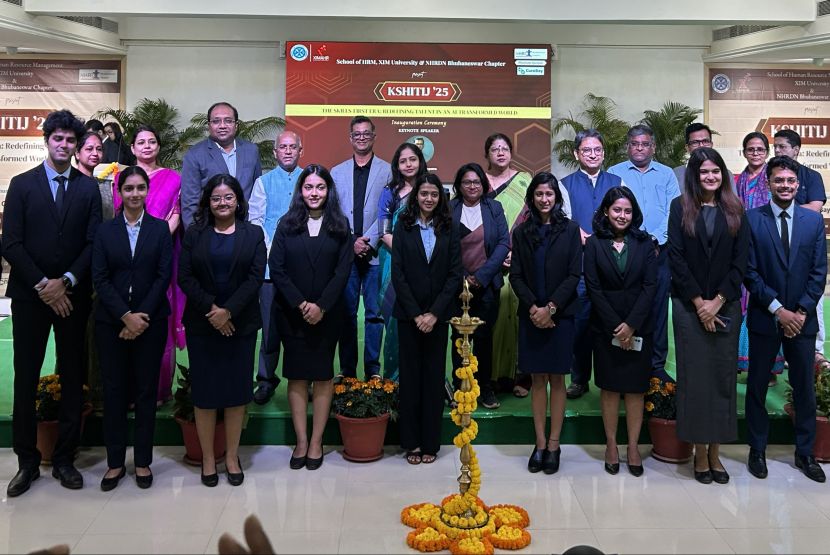
The annual flagship event of XIM University, Kshitij 2025, was conducted with great enthusiasm by the School of Human Resource Management and XIMAHR – The HR Association of XIM University in collaboration with NHRDN – Bhubaneswar Chapter & Platinum Sponsor – CureBay. The theme for this year, “The Skills-First Era: Redefining Talent in an AI-Transformed World,” reflected the rapid evolution of workplace capabilities in the digital age. Organized offline at the Mini Auditorium, XIM University, the event witnessed the presence of distinguished guests, faculty members, and an engaged student audience who gathered to explore the future of HR in technology-driven environments.
The ceremony commenced with the traditional lighting of the lamp, symbolizing the illumination of knowledge and the beginning of new learning pathways. The lamp was lit by the esteemed dignitaries:
Dr Fr K.S. Casimir sj, Vice Chancellor, XIM University;
Fr. S. Antony Raj sj, Registrar, XIM University;
Dr. Andrew Dutta, Dean, School of HRM;
Mr. Priyadarshi Mohapatra, Founder & CEO, CureBay (Keynote Speaker);
and Ms. Bobby Patnaik, President of NHRDN Bhubaneswar Chapter.
Their presence added great significance to the occasion and set a reflective tone for the sessions ahead.
Dr. Andrew Dutta delivered the Welcome Address, warmly greeting the attendees addressing the gathering with an inspiring message on the future of HR leadership. He highlighted that the rise of AI is not a threat but a powerful catalyst for innovation. According to him, HR professionals must become architects of capability, culture, and change. Dr. Dutta emphasized the enduring significance of human qualities such as empathy, intuition, creativity, and ethical decision-making in complementing AI-driven workflows. He encouraged students to adopt a mindset of curiosity and lifelong learning as they prepare to lead organizations through disruption.
Following that Fr. S. Antony Raj sj, in his opening address warmly greeted the attendees and emphasized the transformative role of skills-based talent systems in contemporary organizations. He reflected on the shifting academic and professional landscape, where the relevance of traditional roles is gradually giving way to competency-based learning. He encouraged students to embrace continuous upskilling and adaptability as key drivers of success in the evolving HR domain.
He also challenged the audience to rethink the balance between formal education and experiential skill development. While acknowledging the irreplaceable foundation that academic programs provide, he stressed the urgency of equipping future HR leaders with practical, technology-enabled competencies. He concluded by urging closer collaboration between academia and industry to ensure that learners are well-prepared for emerging roles shaped by artificial intelligence and digital transformation.
Ms. Bobby Patnaik set the context for the conclave by emphasizing the need to rethink traditional templates of work as AI reshapes careers, capabilities, and expectations.She highlighted that success in the coming era will depend on non-linear growth, continual reinvention, and the ability to view the world through new lenses rather than outdated assumptions.Drawing from real-world examples, she encouraged students to stay curious, adaptable, and future-oriented as work becomes increasingly fluid and purpose-driven
Dr Fr K.S. Casimir sj, Vice Chancellor, XIM University, addressed the gathering with an insightful reflection on how AI is transforming the world of work. He emphasized that AI has evolved into an active agent shaping talent needs, work structures, and organizational capabilities. He clarified that the debate between education and skills is misleading, noting that true education builds cognitive strength, emotional maturity, and the ability to learn and adapt continuously.He highlighted that skills-first hiring is rapidly becoming the global norm, with organizations increasingly valuing demonstrable capabilities over traditional qualifications. AI-driven talent systems, he explained, now allow companies to identify capability gaps and enhance internal mobility with unprecedented precision.
Fr. Casimir outlined key shifts defining the future—automation enabling humans to focus on higher-order skills, the rise of dynamic micro-credentials, and agile talent marketplaces that redeploy employees quickly. He encouraged students to explore their strengths boldly, take risks, and embrace lifelong learning. Concluding his address, he urged the school to expand collaborations with leading HR institutions and consider establishing an incubation center to nurture innovation and future-ready talent at XIM University.
The keynote address by Mr. Priyadarshi Mohapatra brought a practitioner’s perspective into the conversation. Drawing from his experiences at Tanishq, Microsoft, and CureBay, he elaborated on how skills-first talent systems are becoming foundational across industries. He shared real-world examples of how AI is augmenting not replacing human capability and discussed how compassion, agility, and analytical thinking remain critical differentiators in the future of work. His address provided valuable insights into how organizations can blend technology with human-centered leadership to create impact at scale.
The inaugural ceremony concluded with the formal launch of HRXpert 2025, the Annual Magazine of XIMAHR & the School of Human Resource Management, symbolizing the school’s continued commitment to thought leadership, research excellence, and creative expression.
Panel Discussion:
The event progressed to the much-anticipated panel discussion on the theme “The Skills-First Era: Redefining Talent in an AI-Transformed World.” The conversation was moderated by Dr. Sanjay Bhattacharya, who opened the session by reflecting on the rapid advancements in artificial intelligence and its deep impact on organizational workflows. He emphasized that while technology continues to accelerate, it is ultimately human capability rooted in adaptability, critical thinking, and emotional resilience that will determine how effectively organizations navigate the future. With this perspective, he invited the distinguished panelists to share their insights, setting an engaging and thought-provoking tone for the discussion.
The first set of reflections came from Mr. Sasanka Sekhar Pati, who highlighted how the accelerating pace of change demands a new kind of talent individuals with strong emotional agility, resilience, and the ability to think critically in dynamic environments. He emphasized that as AI reshapes roles and expectations, organizations must focus on nurturing adaptable talent capable of learning rapidly and navigating ambiguity with confidence. Building on this, Mr. Shyam Sundar Choudhury discussed how business models across industries are being redefined as AI becomes increasingly embedded in operations. He stressed that HR must take the lead in preparing the workforce for this transition by fostering a mindset of lifelong learning and guiding employees to embrace technology as a collaborator rather than a competitor.
Continuing the conversation, Mr. Satyadeep Mishra noted that AI has already shifted from being a futuristic concept to a workplace reality. He emphasized that HR professionals must understand not only emerging technologies but also their practical implications for organizational structures, learning strategies, and future skill needs. Dr. Dinesh Murugesan added that this transformation is particularly visible in large-scale industries such as utilities and energy, where AI-enabled systems are reshaping processes and demanding entirely new capability models. He highlighted the importance of structured upskilling programs, integrated learning pathways, and behavioral development to ensure that employees can adapt effectively to evolving operational roles.
The discussion deepened as Ms. Saema Javed reflected on the human response to AI-driven change. She noted that anxiety and hesitation are natural, but the future belongs to professionals who are willing to embrace technology and develop versatility in both functional and behavioral skills. She emphasized that a skills-first approach requires shifting from fixed job descriptions to dynamic capability-building models that evolve with market and technological demands. Adding to this perspective, Ms. Annapurna A stressed that emotional intelligence will emerge as one of the most critical competencies in the AI era. She explained that while AI can process information, it is human sensitivity, empathy, and collaboration that differentiate strong leaders and enable organizations to thrive in complex environments.
As the discussion progressed, the panelists explored how performance management and leadership are also being redefined in this new landscape. Mr. Sasanka Sekhar Pati emphasized that performance frameworks must evolve to measure adaptability, initiative, and learning capacity, while Mr. Satyadeep Mishra highlighted that leadership in the AI age will require courage, curiosity, and the ability to guide teams through uncertainty. Together, the panel underscored that organizations must invest in capability mapping, dynamic skill development, and transparent communication practices to support transformation at scale.
The session concluded with Dr. Bhattacharya summarizing the key insights shared by the panelists. He emphasized that the future of work will be shaped by a strong Human + AI synergy, where technology augments rather than replaces human potential. He encouraged students to embrace continuous learning, cultivate emotional and cognitive flexibility, and view the skills-first transition not as a disruption but as an opportunity to lead meaningful organizational change. His closing remarks left the audience with a renewed sense of responsibility and inspiration as they prepare to step into a rapidly evolving professional landscape.
Case Competition:
The Case Competition was one of the most prominent highlights of Kshitij 2025, generating widespread excitement and participation from premier B-Schools across the country. The competition aligned with the theme, “The Skills-First Era: Redefining Talent in an AI-Transformed World,” and aimed at evaluating students’ ability to apply innovative, future-forward thinking to real organizational challenges. This flagship event recorded more than 1,600 registrations from 30+ top B-Schools, including TISS Mumbai, XLRI Jamshedpur, IIM Lucknow, SIBM Pune, IIT Madras, and many others, making it one of the most competitive editions to date.
The competition began with Round 1, a domain-focused HR and Business quiz that assessed participants’ conceptual clarity, analytical reasoning, and application of foundational HR principles in emerging AI-driven contexts. This round was designed to test both knowledge and speed, ensuring that only the most competent teams progressed. From this stage, the top 40 teams advanced to the next round, reflecting strong academic preparedness and agility in critical thinking.
In Round 2, the selected teams were presented with a 5-slider case study, developed around the fictional luxury property Hotel Grandeur, which was struggling to navigate capability disruptions brought about by automation, role redesign, and shifting customer expectations. Teams were required to examine issues such as workforce restructuring, capability-building models, talent mobility, onboarding redesign, and newly emerging skill archetypes in the hospitality sector. The challenge demanded not only analytical rigor but also creativity in proposing sustainable, skill-based talent interventions. A distinguished evaluation panel reviewed all submissions and shortlisted the top 10 teams to compete in the final round of presentations.
The Final Round, conducted during the conclave, served as the intellectual centerpiece of the competition. Each finalist team was allotted seven minutes to present its solution, followed by a three-minute Q&A session with the jury. The presentations displayed a strong understanding of skills-first frameworks, job redesign, and the integration of AI into customer-centric service roles. Across the board, teams demonstrated strategic insight, clarity of thought, and an appreciation for the human elements required to complement technological transition in the hospitality industry.
Among the finalists, Team NC Ninjas from TISS Mumbai emerged as the Winners of Kshitij 2025. Their solution stood out for its robust skill-mapping framework, structured redesign of operational roles, and phased integration of AI-enabled service systems.
The First Runners-Up, Team Case-a-holics from XLRI Jamshedpur, impressed the jury with their compelling emphasis on employee empowerment, talent mobility pathways, and the redesign of learning ecosystems for frontline staff.
The Second Runners-Up, Team Phoenix from the School of Human Resource Management, XIM University, were commended for their innovative use of AI-driven onboarding systems, gamified skilling modules, and structured behavioral capability enhancement.
The jury also recognized three special mentions, awarded under the category of The Bravos.
These teams were:
- K Factor – School of Human Resource Management, XIM University
- InnovateX – IIM Lucknow
- TriXcel – School of Human Resource Management, XIM University
Each Bravo team was lauded for its creativity, clarity of execution, and fresh perspectives on redefining talent systems through skill-centered interventions.
The esteemed jury for Kshitij 2025 included:
- Shradha Padhi, Additional Director, Regional College of Management, Bhubaneswar
- Padmalaya Mandhata, Sr. Manager – Business Partner HR, Infosys Ltd.
- Arup Roy Chowdhury, School of HRM, XIM University
The judges expressed appreciation for the participants’ enthusiasm and the range of innovative models proposed. They highlighted how the competition showcased a promising generation of HR professionals who are well-equipped to navigate the intersection of technology and human capability. Their constructive feedback encouraged teams to refine their analytical storytelling and integrate stronger impact metrics when designing solutions for real organizational contexts.
The Case Competition concluded with a warm and celebratory prize distribution ceremony. The finalists were felicitated by the dignitaries, who acknowledged the remarkable effort, intellect, and professionalism demonstrated throughout the competition. The energy and diligence displayed by all participants made the event a memorable and enriching component of Kshitij 2025, reinforcing the conclave’s mission of fostering critical thinking, innovation, and leadership among future HR professionals.
Closing Remarks:
Ms. Padmalaya Mandhata shared her reflections as a jury member, expressing appreciation for the thoughtful approaches demonstrated by the participating teams. She emphasized that while information is widely accessible today, the true differentiator lies in how students gather, interpret, and build meaningful solutions from it. Drawing from her experience in the IT industry, she highlighted the importance of prompt engineering and the effective use of AI tools, noting that technology alone cannot replace the analytical effort required to craft a strong case solution. She encouraged students to invest time in understanding the problem deeply rather than relying solely on generative tools, reminding them that while presentation skills were excellent across teams, the core focus remains the quality and feasibility of the proposed solution. Mrs. Mandhata also underscored that in any real-world scenario, execution may take 20%, but planning accounts for the remaining 80%, making structured thinking essential. She expressed gratitude for the longstanding association between NHRDN and XIM University, and appreciated the opportunity to engage with students and witness their evolving talent and problem-solving capabilities.
Vote of Thanks:
The event concluded with a heartfelt Vote of Thanks delivered by Ms. Rujuta Ashtekar, Coordinator of XIMAHR, who expressed sincere gratitude to everyone who contributed to the success of Kshitij 2025. She thanked all the dignitaries, panel members, jury members, faculty of the School of HRM, XIMAHR Faculty Advisors, and the entire administration, maintenance, and support staff which made the event a success. She also appreciated Team X-Lens for capturing the event. In closing, she thanked all participants and attendees for their enthusiasm, reaffirming that Kshitij continues to inspire and prepare future HR leaders.
Outcomes / Takeaways:
The outcomes of Kshitij 2025 were multi-dimensional, offering students a comprehensive understanding of how talent, technology, and capability-building are converging to shape the future of work. The conclave provided a powerful platform for participants to rethink HR practices through the lens of a skills-first philosophy, encouraging them to view artificial intelligence not as a disruptor but as an enabler of human potential. Through discussions, keynote insights, and case-based problem-solving, students developed a deeper appreciation of the role HR leaders must play in steering organizations through rapid technological and cultural change.
The sessions emphasized the importance of embedding continuous learning, adaptability, and innovation within organizational ecosystems. Participants gained clarity on how companies are redesigning roles, restructuring work models, and cultivating cross-functional skills to remain competitive in dynamic environments. The panel discussions demonstrated how capability-based workforce strategies can empower employees to thrive in AI-augmented workplaces while supporting organizational resilience. Students also recognized the growing significance of ethical leadership, data literacy, and human-centered decision-making as fundamental competencies for tomorrow’s HR professionals.
The case competition reinforced the need for strategic thinking, creativity, and evidence-based problem-solving. By analyzing real-world challenges faced in the fictional case of Hotel Grandeur created by XIMAHR, participants learned how skill architectures, AI-assisted HR systems, and redesigned workforce models can transform industries undergoing digital disruption. The competition encouraged teams to balance operational efficiency with employee development, ensuring that technology adoption is matched by strong capability-building frameworks.
Overall, Kshitij 2025 inspired students to embrace a future-ready mindset rooted in curiosity, collaboration, and continual skill enhancement. The conclave highlighted that the path forward for HR lies not only in managing people but in architecting talent ecosystems that can adapt, innovate, and excel in an AI-transformed world. Through its discussions, competitions, and shared experiences, Kshitij 2025 successfully equipped students with actionable perspectives and reinforced the growing relevance of skills-first strategies in shaping sustainable organizational growth.


