
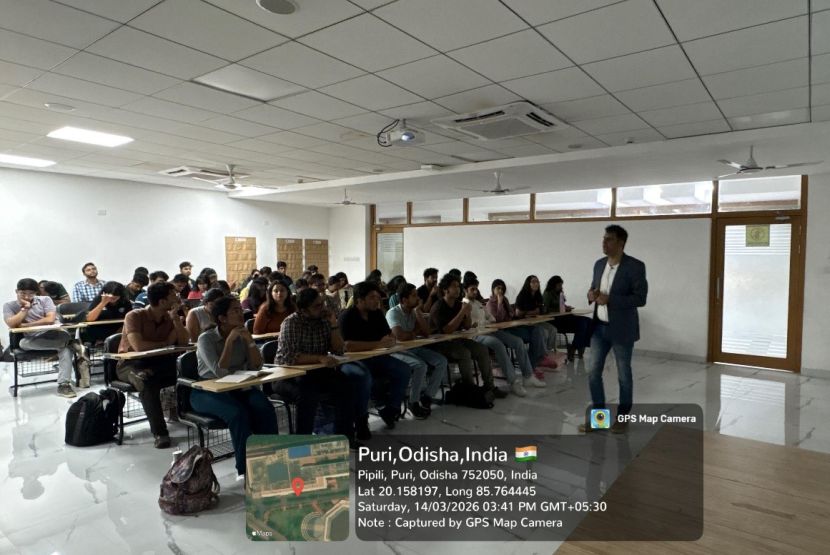
Speaker: Mr. Suman Paul, Director – Rewards for South & North Asia, APAC – HR, Dentsu international
Date: 14/03/2026
Theme: Organization Structure & Design
The first-year students of the School of Human Resource Management had the unique opportunity to interact with and learn from Mr. Suman Paul, Director – Rewards for South & North Asia, APAC – HR at Dentsu international, as part of their Leadership Talk series. Mr. Paul is an accomplished HR leader with over two decades of experience across industries such as pharmaceuticals, banking, and media & entertainment. The session delivered a comprehensive exploration of organizational design principles through real-world business case studies and strategic frameworks.
Talk Summary
Mr. Paul began the session by defining organizational design as the strategic alignment of roles, resources, reporting structures, and leadership. He introduced Jeff Bezos’s principle – “If you can’t feed a team with two pizzas, the team is too big” – and outlined four core business strategies: Cost Leadership (Walmart), Product Innovation (Google), Customer Intimacy (Deloitte), and Platform Ecosystem (Amazon). The session examined organizational design determinants – goals, strategy, environment, culture, technology, and size – and their influence on structural characteristics like formalization, specialization, hierarchy, and centralization.
Through comprehensive case studies, Mr. Paul analyzed diverse organizational structures: UPS’s centralized model for operational consistency, Starbucks’ decentralized “Third Place Philosophy” empowering frontline staff, Zara’s agile cross-functional structure managing the full value chain for fast fashion responsiveness, Nike’s network structure focusing on branding while outsourcing production, and Apple’s evolution to a functional structure where decision rights rest with technical experts.
Students engaged with nine types of organizational structures and examined how Amazon, Walmart, and Zara’s design determinants align with their respective business strategies. The session included two interactive business case-lets where students collaboratively applied organizational design principles to real-world scenarios. Mr. Paul concluded by sharing insights into dentsu international’s organizational approach and his experiences driving HR strategy, organizational effectiveness, and rewards frameworks across multiple markets in the APAC region.
Key Insights from the Session
- Organizational Design Fundamentals: Roles, resources, reporting structures, and leadership must align strategically.
- Team Size Principle: Jeff Bezos’s “two-pizza team” rule emphasizes manageable team sizes for effective collaboration.
- Strategy-Structure Alignment: Different business strategies (cost leadership, innovation, customer intimacy, platform ecosystem) require different organizational structures.
- Design Determinants: Goals, strategy, environment, culture, technology, and size shape organizational structure.
- Centralization vs. Decentralization: UPS demonstrates centralization for operational consistency; Starbucks shows decentralization for employee empowerment.
- Network Structures: Companies like Nike leverage network models focusing on core competencies while outsourcing production.
- Full Value Chain Control: Zara’s integrated design-to-distribution model enables rapid market responsiveness.
- Functional Expertise: Apple’s shift to functional structure places decision-making with technical experts rather than hierarchical positions.
- Strategic Agility: Flat, cross-functional structures (like Zara) enable faster decision-making and market adaptation.
Student Interaction (Q&A Highlights)
- Why does UPS have such high centralization while Starbucks is decentralized?
Mr. Paul explained that UPS operates in logistics where consistency, standardization, and operational efficiency across thousands of locations are critical. Centralization ensures uniform processes and quality control. Starbucks, however, prioritizes customer experience and local responsiveness, requiring frontline staff empowerment and decentralized decision-making to create the “third place” experience.
- What organizational structure do Amazon, Walmart, and Zara follow, and why?
Mr. Paul detailed how Amazon employs a platform ecosystem structure enabling marketplace scalability, Walmart uses a functional structure with strong centralization for cost leadership, and Zara operates with a flat, agile, cross-functional structure managing the complete value chain for speed and responsiveness in fast fashion.
Conclusion
The session provided valuable insights into how organizational design serves as a critical enabler of business strategy. Mr. Paul emphasized that effective organizational structures align with strategic goals, leverage appropriate design determinants, and balance centralization with empowerment based on industry context. By examining diverse companies from UPS to Nike to Apple, students gained practical understanding of how structure influences operational efficiency, innovation capability, and market responsiveness. The interactive case analysis helped students apply theoretical frameworks to real-world organizational challenges, deepening their appreciation for strategic HR leadership in driving organizational effectiveness.